Remembrance
Text: Poetry, by W. B. Yeats (Standard Ebooks, 2024), from the collected editions of 1908 to 1928. Public domain.
In brief
SummaryThinking of an absent beloved at nightfall, the poet feels their souls meet.
The speaker is thinking of someone he loves who is not with him. Three times he says "Remembering thee": he gathers "faint flowers / Of rhyme" for her, and muses while the evening light fades over dewy grass and willows. Above him a star seems to sing of "ceaseless loneliness and high regret". In the last two lines his soul rises to touch that star, and across all that distance the two of them meet, "made equal with a sigh". It is a young poet's sonnet, lush with sound, turning loneliness into a moment of union.
Lines to remember
The honey-hearted leisure of the light,
Sings the young wistful spirit of a star
Line by line
Lines 1 to 5Flowers of rhyme
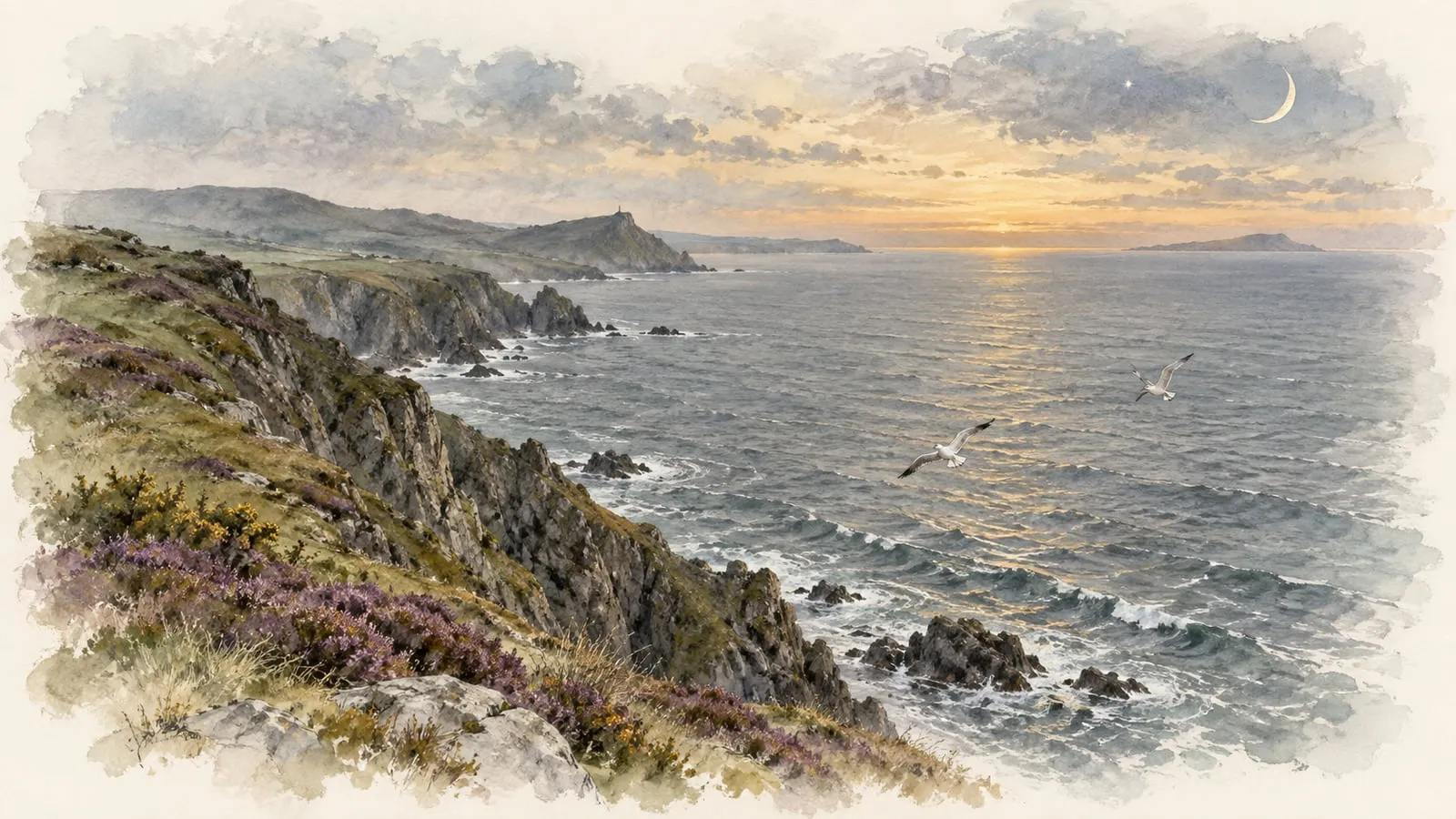
He calls his poems "faint flowers / Of rhyme", picked in her memory on a "crescent night". The hours are pictured as solemn figures with "purple sandals" sweeping over buds and grass wet with the dew of "odorous showers". Everything is soft, scented and slow.
Lines 6 to 8The light goes
The refrain comes a third time. He muses as "The honey-hearted leisure of the light" fades, a phrase that makes evening sound sweet and unhurried. The eighth line, hanging "o'er the hush of willow bowers", runs on without a stop into the next stanza.
Lines 9 to 12The singing star
The sentence at last reaches its subject: "the young wistful spirit of a star", low in the eastern shadows, sings of loneliness and regret. The star's song mirrors the speaker's own feeling, and the silence around it is oddly festive, "holding revelry and feast".
Lines 13 to 14A meeting in space
"Just now" brings the poem into the present. His soul rises and touches the star, and "far / In space" the two meet, "made equal with a sigh". Whether the star stands for the absent beloved or for his own longing, the loneliness is shared for a moment.
Themes
Absence and memory
The poem is built on the repeated "Remembering thee", which opens three of its first six lines. The beloved never appears; she exists only in his thoughts and in the poems he makes for her. Memory is what drives everything he does and sees, from gathering rhymes to watching the evening fade.
Loneliness shared
The star sings of "ceaseless loneliness and high regret", the speaker's own mood written across the sky. The ending turns this loneliness into contact: two distant things meet "far / In space" and are "made equal with a sigh". Sorrow becomes the very thing that joins them.
Context
This is one of Yeats's early poems that he did not keep in his collected work, and our text comes from the Standard Ebooks edition of his poetry. Its details of first publication are not confirmed here. The rich, decorative diction ("grave-eyed hours", "honey-hearted leisure") shows the young Yeats writing under the influence of the English Romantic and Victorian poets, before he found his plainer voice.
Form
A sonnet of fourteen pentameter lines, rhymed in the Italian way: an octave on two rhymes (ABBAABBA: "flowers", "night", "bright", "showers") and a sestet rhymed CDEEDC. The octave is one long, drifting sentence full of "o'er" and compound adjectives, so the verse moves as slowly as the dusk it describes.