Lapis Lazuli
About the text
Yeats first published this poem in 1938. It is out of copyright in Ireland and the EU, but in the United States it stays in copyright until the start of 2034, and this site is served partly from American servers. So for now we give the notes without the full text; it will appear here in 2034.
It begins: I have heard that hysterical women say
In brief
SummaryFacing war and ruin, Yeats finds joy in tragic art and ancient wisdom.
The poem opens with the complaint of women Yeats calls hysterical: they are sick of painters, musicians and poets who stay cheerful while everyone knows that bombs may soon flatten the towns. He answers with the theatre. Actors who play Hamlet or Lear do not break off their lines to weep, because tragedy at its height brings a gaiety that transfigures dread. Civilisations too rise and fall; nothing of the great sculptor Callimachus survives; all things fall and are built again, and those who rebuild are gay. The poem ends with a carving in lapis lazuli: two Chinese sages and a servant climbing a mountain towards a little house. Yeats imagines them seated there, looking down on the whole tragic scene, asking for mournful music, their ancient, glittering eyes gay.
Lines to remember
Gaiety transfiguring all that dread.
All things fall and are built again,
Line by line
Lines 1 to 8Sick of the palette
Yeats reports the complaint of some women he calls hysterical: they are tired of painters, musicians and poets who are always cheerful, when everyone knows that unless something drastic is done, aeroplanes and Zeppelins will come and bomb the town flat, as King Billy's guns once did. The tone is sharp and dismissive.
Lines 9 to 24Hamlet and Lear are gay
His answer is tragedy on the stage. Actors playing Hamlet, Lear, Ophelia and Cordelia, if worthy of their parts, do not break up their lines to weep as the last curtain falls. They know the tragic hero is gay: at the moment of loss, heaven blazes into the head. Tragedy at its height cannot grow any greater, however many stages play it.
Lines 25 to 36Civilisations fall
History shows the same pattern. Old civilisations arrived on foot, by ship or on the backs of camels, horses, asses and mules, and were put to the sword, and their wisdom went to ruin. Nothing of the sculptor Callimachus still stands; his famous lamp lasted only a day. All things fall and are rebuilt, and the rebuilders are gay.
Lines 37 to 42The carving
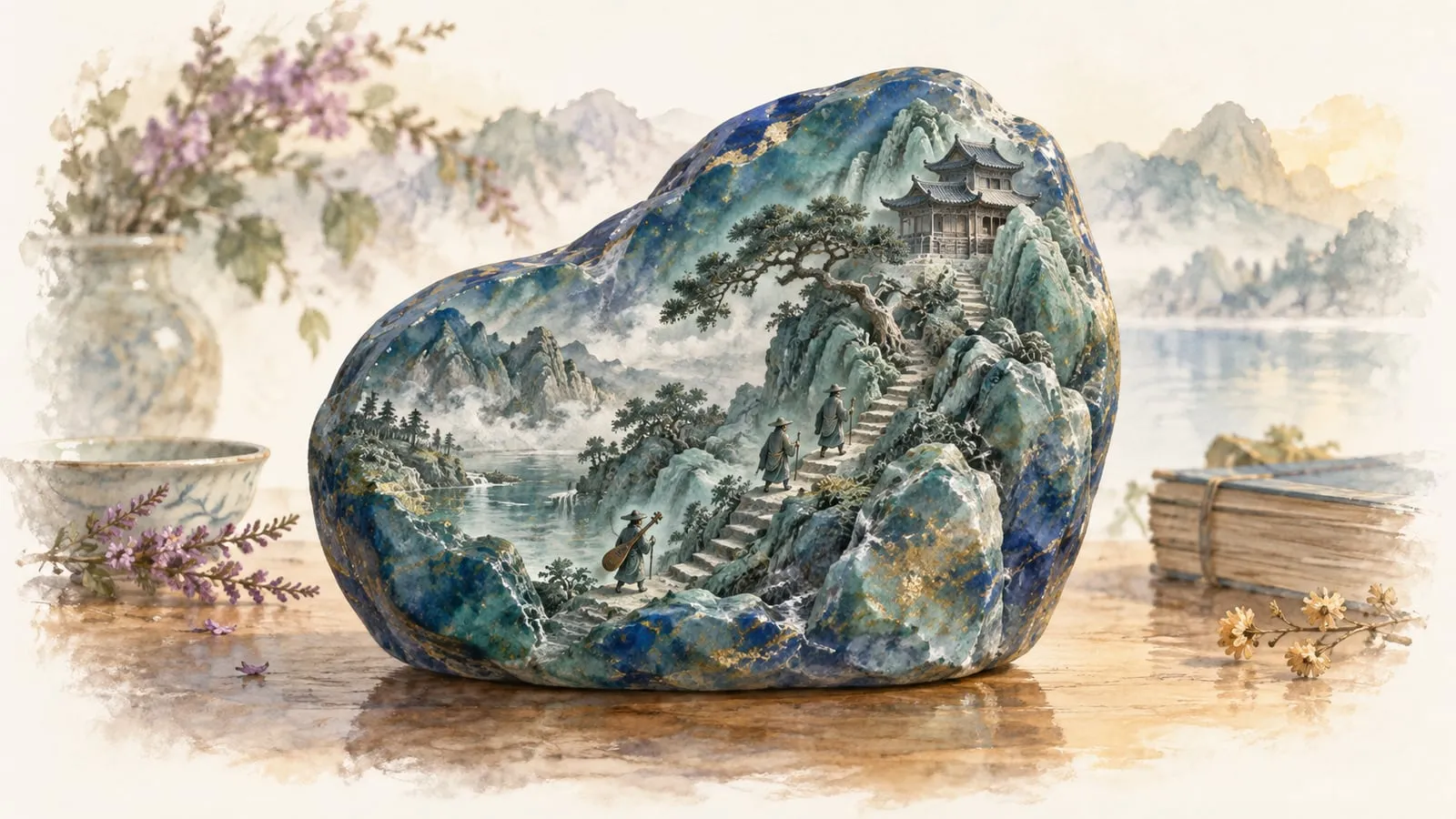
Yeats turns to the carving itself: two Chinese figures, with a third behind them, carved in lapis lazuli, and a long-legged bird flying above them as a symbol of long life. The third, surely a servant, carries a musical instrument. After the sweep of history, the description is quiet and exact.
Lines 43 to 56Ancient, glittering eyes
Every crack and discoloured patch in the stone seems a stream, an avalanche or a snowy slope. Yeats imagines a little half-way house sweetened by plum or cherry blossom, where the climbers sit and stare down on the tragic scene. One asks for mournful music, skilled fingers play, and their wrinkled eyes are gay.
Themes
Tragic joy
The poem's key word is "gay", repeated through every section. It does not mean careless. It is the exhilaration of those who see disaster clearly and do not flinch: the actor at the final scene, the rebuilder among ruins, the sages listening to mournful music. "Gaiety transfiguring all that dread" names the heart of Yeats's late philosophy.
Art and destruction
The opening complaint assumes that art is frivolous in a time of war. Yeats replies that art is how humans face catastrophe. Works of art may perish, as Callimachus's did, but the making goes on. The lapis carving, itself a survivor, shows art turning an accidental crack into an avalanche and a threat into a scene of contemplation.
Cycles of history
Civilisations come and go: "All things fall and are built again". The third section sweeps through wandering peoples, conquests and lost masterworks without lament. For Yeats, history moves in cycles, and the right response to collapse is not despair but the energy to rebuild, which he again calls gaiety.
Wisdom of age
The final figures are old, their eyes set among many wrinkles, and they sit above the world looking down on its tragedy. Their calm is not indifference: they ask for mournful melodies. Written by a poet past seventy, the ending imagines an old age that has seen everything and can still delight.
Context
The poem was first published in New Poems (Cuala Press, Dublin, 1938). The carving was a real object: a piece of Chinese lapis lazuli carved as a mountain with figures, given to Yeats for his seventieth birthday in 1935 by a young admirer, Harry Clifton, to whom the poem is dedicated.
It was written in the mid-1930s, when many feared another European war and bombing from the air, and when writers were urged to make art serve politics. Yeats replies that art faces catastrophe with tragic joy. King Billy is William III, whose forces defeated James II in Ireland in 1690; the Zeppelins were the German airships that bombed Britain in the First World War.
Form
Five verse paragraphs of unequal length (8, 16, 12, 6 and 14 lines) in loose lines of four or five beats, rhymed often but irregularly, with many half rhymes. The shape follows the argument: jagged, crowded early sections of complaint and history give way to the slower, quieter description of the stone, so the poem itself climbs towards calm.