Down by the Salley Gardens
Earlier titled "An Old Song Re-sung"
Listen
Text: Poetry, by W. B. Yeats (Standard Ebooks, 2024), from the collected editions of 1908 to 1928. Public domain.
In brief
SummaryA young man ignores his sweetheart's advice to take love easy, and regrets it.
A simple song of young love and regret. The speaker remembers meeting his love by the salley gardens and standing with her in a field by the river. Twice she tells him to take things easy, love in the first stanza and life in the second, as naturally as leaves grow on a tree or grass on the weirs. Twice he refuses, because he was "young and foolish". The last half-line brings the story up to the present: "and now am full of tears".
Lines to remember
Down by the salley gardens my love and I did meet;
She bid me take love easy, as the leaves grow on the tree;
But I was young and foolish, and now am full of tears.
Line by line
Lines 1 to 4Take love easy
The lovers meet by the salley gardens and she passes with "little snow-white feet". She tells him to "take love easy, as the leaves grow on the tree": let it come naturally and without strain. He, "being young and foolish", will not agree, and the comparison with leaves makes her advice sound like the wisdom of nature itself.
Lines 5 to 8Take life easy
The second stanza repeats the pattern with small, telling changes. Now they stand by the river, her "snow-white hand" on his shoulder, and her advice widens from love to life. "Being young" becomes "I was young", a shift into the past tense, and the poem ends on what that foolishness has cost him: "now am full of tears".
Themes
Youth and regret
The whole poem turns on one line, repeated with a difference: "But I, being young and foolish" becomes "But I was young and foolish, and now am full of tears". The speaker is older now and looks back at a mistake he cannot undo. The regret is never explained in detail, which lets it stand for any love lost through impatience.
Love and nature
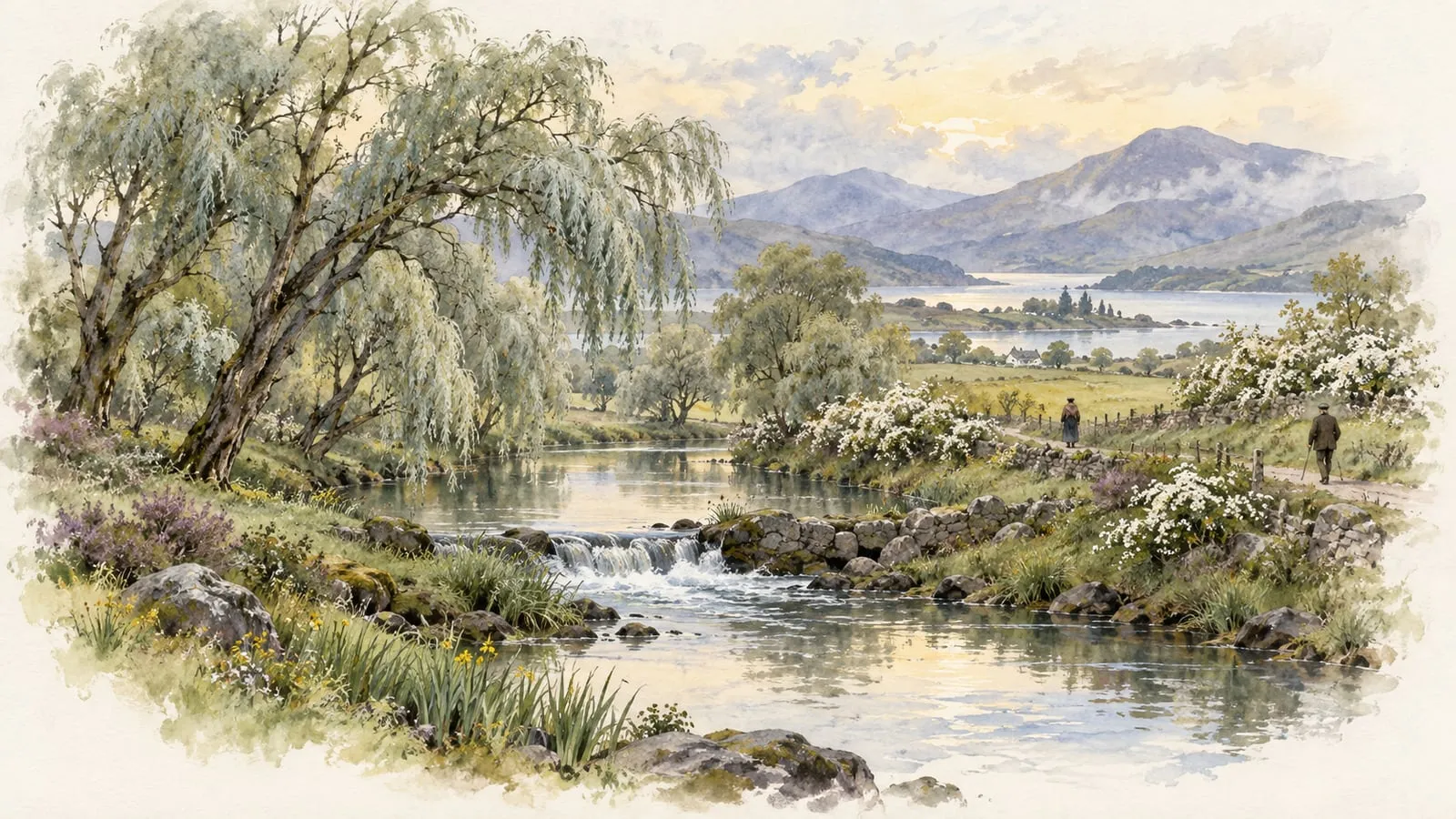
The young woman's advice is drawn from the natural world: love should come "as the leaves grow on the tree", life "as the grass grows on the weirs". Leaves and grass grow without forcing, season by season. The willows of the salley gardens and the "field by the river" set the lovers in an ordinary country place, where her wisdom seems to belong.
Context
The poem appeared in The Wanderings of Oisin and Other Poems in January 1889, under the title "An Old Song Re-sung", among the early lyrics Yeats later grouped as "Crossways". Yeats's note called it an attempt to reconstruct an old song from three lines imperfectly remembered by an old peasant woman in the village of Ballisodare, County Sligo, who often sang them to herself.
It became one of his best-known poems through music. The composer Herbert Hughes set it in 1909 to the traditional Irish air "The Maids of Mourne Shore", and that tune is how most people now know it. Benjamin Britten arranged Hughes's tune for voice and piano in 1943, and it is still sung in concert halls and at kitchen tables alike.
Form
Two quatrains of long, swinging lines of seven beats, rhymed in couplets ("meet" and "feet", "tree" and "agree"). The second stanza closely repeats the first, as a folk song repeats its tune. The balanced halves of each line, with a pause in the middle, make it easy to sing.
Titled 'An Old Song Re-sung' in 1889.