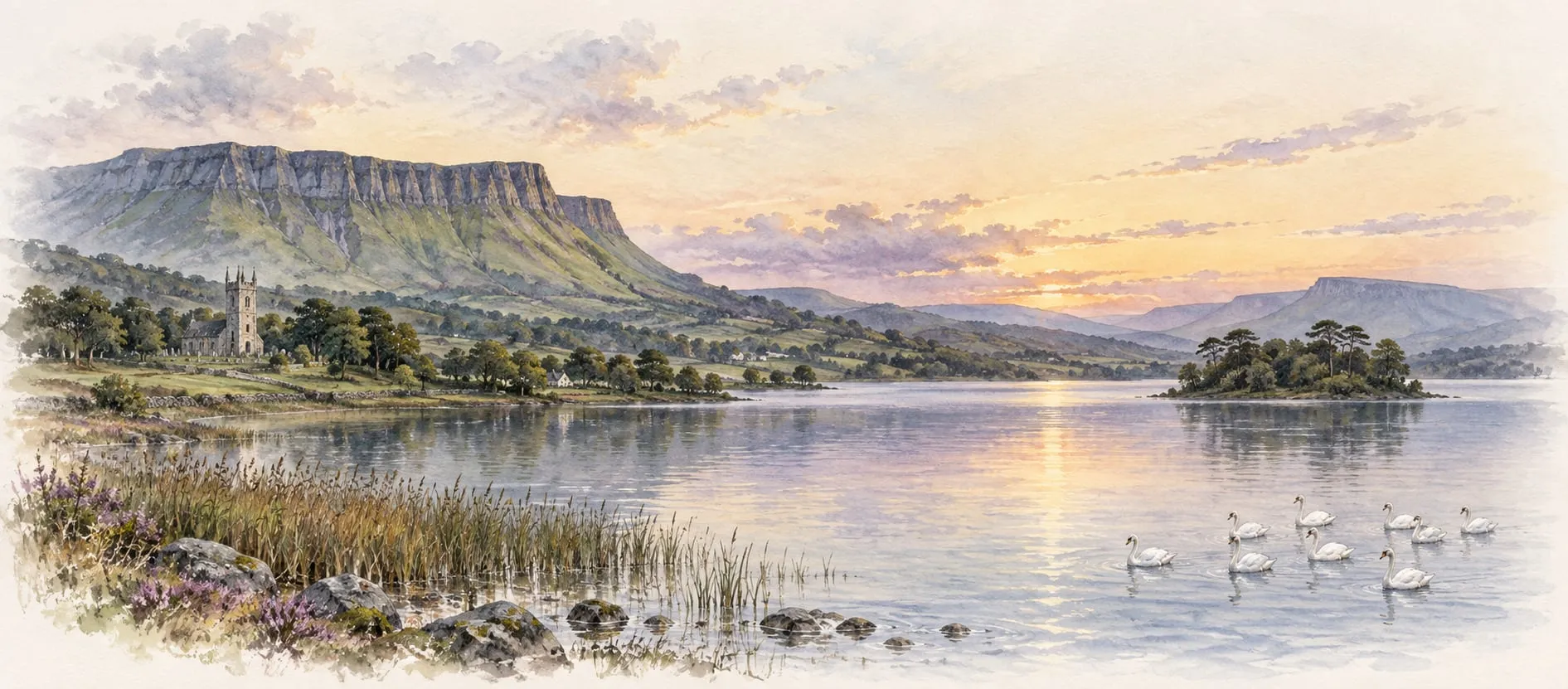
A Summer Evening
Text: Poetry, by W. B. Yeats (Standard Ebooks, 2024), from the collected editions of 1908 to 1928. Public domain.
In brief
SummaryOn a summer evening, nature forgets autumn and death, and a girl should too.
On a summer evening the woods seem to forget their fear of autumn: they "shake their birds upon the air" and ring like a silver trumpet. The bee hums with no thought of "the sulphurous end", and the sunflowers play as if their season would never end. The speaker then turns to a young woman and asks her to be happy too, to lay down "the burden of thy race", because God is "walking in the dew". The last stanza repeats the first, now with a reason: the woods feel God there and no longer dread the autumn.
Lines to remember
And shake their birds upon the air,
For God is walking in the dew,
Line by line
Lines 1 to 4The woods rejoice
Autumn is pictured with a "mortal wing", like a bird of prey, but the woods "forego their care". The lovely image "shake their birds upon the air" makes the birds seem like leaves or bells shaken loose, and the woods "ring" like a silver trumpet.
Lines 5 to 8The careless bee
The bee's "complacent croon" is "honey-thickened", heavy and sweet like summer itself. It has "no word of the sulphurous end", a phrase that points to death, or even the fire at the end of the world, which the bee knows nothing about.
Lines 9 to 12The sunflowers
The sunflowers behave "As though their season had no date". They nod politely to Time's "iron shoes" and "play with his immortal hate", treating their great enemy lightly, like children teasing a giant.
Lines 13 to 16To the maiden
Now the poem speaks to a person. The "maiden" should be "mirthful too" and put down "the burden of thy race", the sorrow humans carry because they know they must die. The reason is given plainly: "God is walking in the dew".
Lines 17 to 20The woods again
The opening stanza returns with one change: the woods now "feel Him there" and "dread no more foul autumn's wing". The repetition turns the first stanza's carelessness into trust.
Themes
Time and death
Behind the summer scene stand autumn's "mortal wing", the "sulphurous end" and Time's "iron shoes". Nature does not escape these; it simply ignores them, as the sunflowers "play with his immortal hate". Only humans carry the knowledge of death, which is why the maiden bears "the burden of thy race".
God in nature
The answer the poem offers is religious: "God is walking in the dew", like God walking in the garden of Eden in the evening in Genesis. The "evening presence" that "fills the place" is what lets the woods "dread no more". Joy, in this poem, rests on trust rather than forgetting.
Context
This is one of Yeats's early poems that he did not keep in his collected work, and our text comes from the Standard Ebooks edition of his poetry. Its details of first publication are not confirmed here. The contrast between careless nature and anxious humanity, and the fear of time, would stay with Yeats long after this youthful, hopeful answer.
Form
Five quatrains of four-beat iambic lines rhymed ABAB ("care", "wing", "air", "ring"). The last stanza repeats the first with only two lines changed, framing the poem. The regular, bright rhythm matches the "silver trumpet" of the woods.