The Phantom Ship
Text: Poetry, by W. B. Yeats (Standard Ebooks, 2024), from the collected editions of 1908 to 1928. Public domain.
In brief
SummaryIn a midnight storm, a fishing village sees a ship crewed by its drowned.
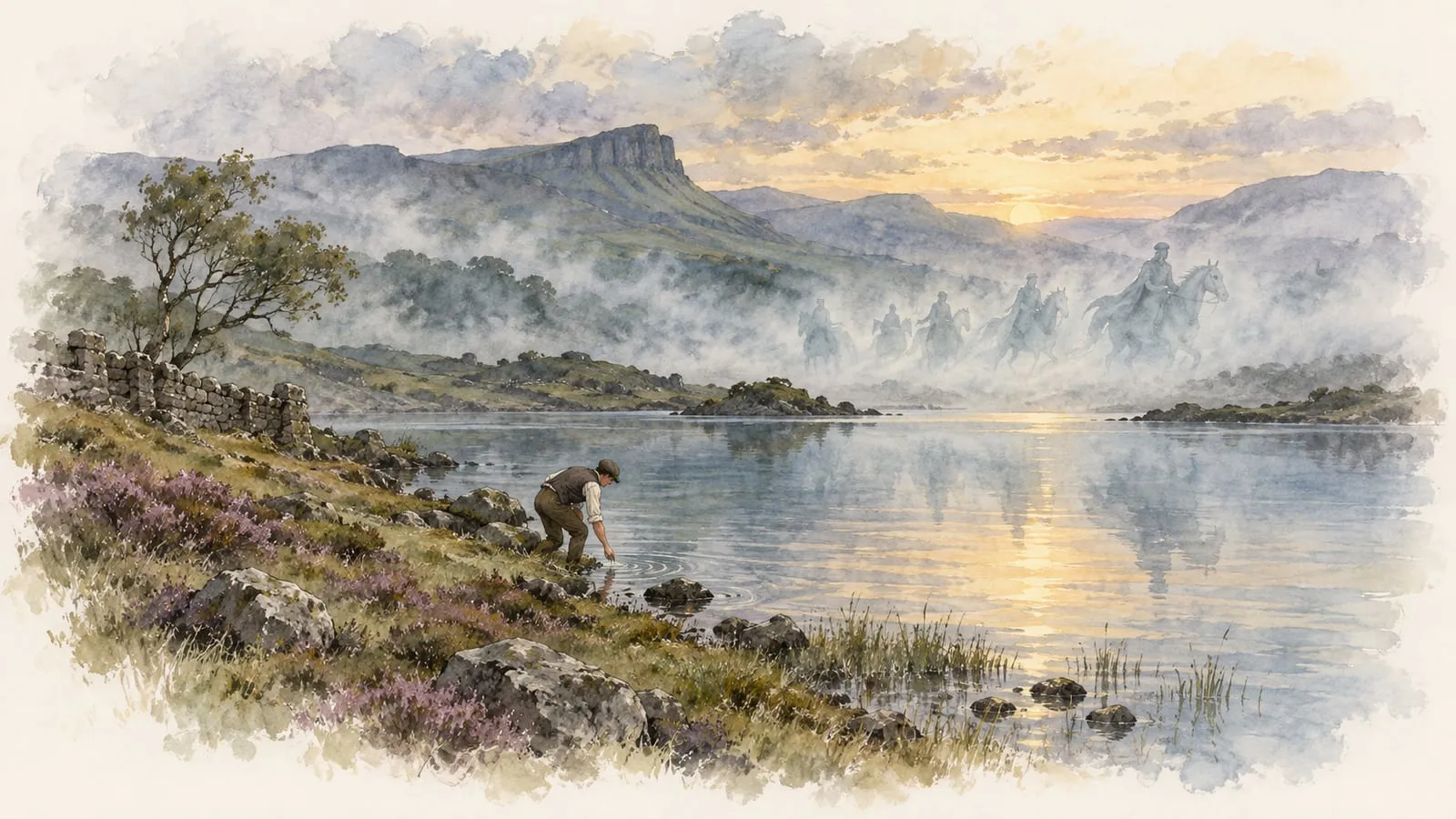
A sudden storm breaks over a fishing village at midnight. A watcher wakes the sleeping fishers, who run to the harbour wall and see a vessel come out of the darkness under full sail while the chapel bell tolls by itself. The ship comes round, the wind drops, and on deck stand "All the drowned that ever were drowned from that village by the sea", lit by ghostly flames. Mothers and wives call out the names of their dead. Then mist hides the phantoms and they are gone. A priest cries out to pray for the souls in purgatory, and the people pray until dawn.
Lines to remember
All the drowned that ever were drowned from that village by the sea;
By the slow heaving ocean, mumbling mother of the dead.
Line by line
Lines 1 to 6The storm breaks
Lightning is "the shuttle" flying across the sleet, as if weaving the storm. Stars and moon are "puffed away and dead". The storm came so fast the children were scarcely in bed; it had been hiding in the twilight "as the worm within the nut".
Lines 7 to 12The call
A voice cries "Waken, waken, sleepy fishers" at midnight. The fishers run half blinded by lightning and follow the watcher's "lean hand" to see the darkness "slow disgorging a vessel blind with squall".
Lines 13 to 18The bell tolls
They shout practical orders ("Bring the ropes now!") and marvel at the canvas she carries. Then the chapel bell begins tolling with no ringer, "as though the dead passed by". The ship comes about, and wind and sails fall silent.
Lines 19 to 24The drowned crew
A scream: on deck stand all the village's drowned, with "ghastly ghost-flames" glimmering on their hands and faces and on the rigging. A mother calls her son by name, and then every wife, maid and mother calls some "drownèd one".
Lines 25 to 30The ship fades
The phantoms stand grey and silent, with joys and fears "that the live earth knoweth not". Vapours fall and the wind carries them away. Mist hangs "like cobwebs in the air", and the stars return.
Lines 31 to 34Prayer till dawn
A "pale priest" calls them to pray for the souls in purgatory. They pray until "olive fires of morning" appear, and the poem ends on the sea itself, the "mumbling mother of the dead".
Themes
The sea and the dead
The sea gives this village its living and takes its men. The phantom ship makes that loss visible all at once: "All the drowned that ever were drowned". The final image of the ocean as the "mumbling mother of the dead" makes the sea both a grave and a parent.
Grief and faith
The most moving moment is quiet: a mother calling her drowned son by name, then every woman calling hers. The dead do not answer. The priest's cry to pray "for the souls in purgatory" turns shock into ritual, and the village's Catholic faith carries it through to morning.
Context
This is one of Yeats's early poems that he did not keep in his collected work. It was printed in The Wanderings of Oisin and Other Poems (1889). Its ghostly sea story belongs with the folk tales of coastal Ireland that Yeats was collecting and retelling in these years, though the village is not named.
Form
Thirty lines of long, loose couplets with eight beats and a strong trochaic swing ("Flames the shuttle of the lightning across the driving sleet"), then a single line standing alone and a closing three-line group in shorter rhymes. The rolling metre suits a ballad told aloud, and the break into short lines slows the ending into prayer.