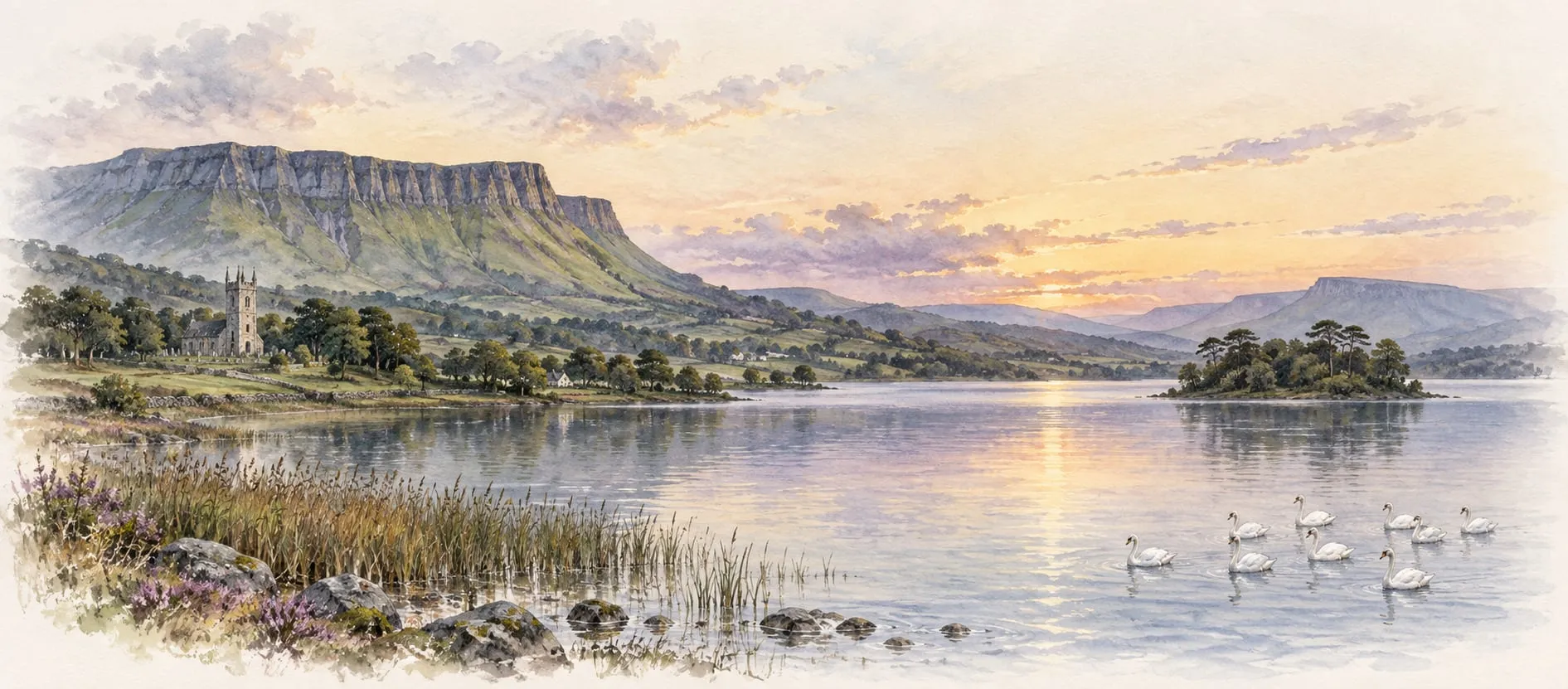
Stream and Sun at Glendalough
About the text
Yeats first published this poem in 1932. It is out of copyright in Ireland and the EU, but in the United States it stays in copyright until the start of 2028, and this site is served partly from American servers. So for now we give the notes without the full text; it will appear here in 2028.
It begins: Through intricate motions ran
In brief
SummaryA sudden gleam at Glendalough frees the poet from brooding self-reproach.
Watching the stream and the sunlight moving together in intricate patterns, the poet feels his heart grow light, until the memory of some stupid thing he once did distracts him. He reflects that repentance itself keeps his heart impure, and asks what right he has to think he could behave better, or have more sense, than a common man. Then comes a moment of illumination: some movement of sun, stream or eyelid shoots a gleam through his body, and he asks what made him live, for that moment, like these things that seem self-born and born anew.
Lines to remember
Repentance keeps my heart impure;
Line by line
Lines 1 to 5Stream and sun
Stream and sun run through intricate motions, and his heart seems gay. Then a memory of something foolish he had done pulls his attention away. The shift from outward beauty to inward fretting happens in a single line.
Lines 6 to 10Repentance and pride
He sees that repentance keeps his heart impure, since brooding on faults keeps him bound to them. And who is he to imagine he could behave better or have more sense than an ordinary man? Humility undoes the self-reproach.
Lines 11 to 15The gleam
A gleam from sun, stream or even an eyelid pierces his body. He asks what made him live like these natural things, which seem to be born of themselves and born again each moment. The poem ends in questions, but the mood is release.
Themes
Remorse
The central paradox is that repentance "keeps my heart impure". Endless self-blame is a kind of pride, as if one ought to be better than everyone else. Yeats makes a related case at the end of "A Dialogue of Self and Soul", where casting out remorse lets sweetness flow into the breast.
Moments of grace
The last stanza records a brief, unexplained illumination. Light from the stream, the sun or an eyelid pierces the body, and for a moment he feels renewed like the natural world, which is always "born anew". Similar sudden blessings appear in "Vacillation", where his body blazes in a London shop.
Context
The poem was collected in The Winding Stair and Other Poems (Macmillan, 1933). Glendalough, in the Wicklow Mountains, is a valley of two lakes and the site of the early monastery founded by St Kevin, a place long associated with prayer and solitude. The poem belongs with the late meditations on remorse and joy in that collection, such as "Vacillation" and "A Dialogue of Self and Soul".
Form
Three five-line stanzas of short lines of three or four beats, rhymed but in a shifting pattern, with near-rhymes such as "ran" and "sun". The last stanza tightens into firmer rhyme ("stream", "gleam", "seem") as the vision arrives. Questions close the second and third stanzas, keeping the tone searching rather than certain.