His Memories
His Memories
Text: Poetry, by W. B. Yeats (Standard Ebooks, 2024), from the collected editions of 1908 to 1928. Public domain.
In brief
SummaryAn old man, mocked by women now, remembers lying with Helen.
The sixth poem of "A Man Young and Old", where the speaker is now an old man. Old people should keep out of sight, he says, being only "holy shows", bodies broken like a thorn in the north wind, thinking of the dead Hector that nobody living remembers. Women now care so little for what he says that they would rather hear a donkey bray. Yet in these twisted arms beauty once lay: the first of her kind, the woman who "brought great Hector down", took such pleasure there that she cried into his ear, "Strike me if I shriek."
Lines to remember
My arms are like the twisted thorn
And yet there beauty lay;
Strike me if I shriek.
Line by line
Lines 1 to 6Holy shows
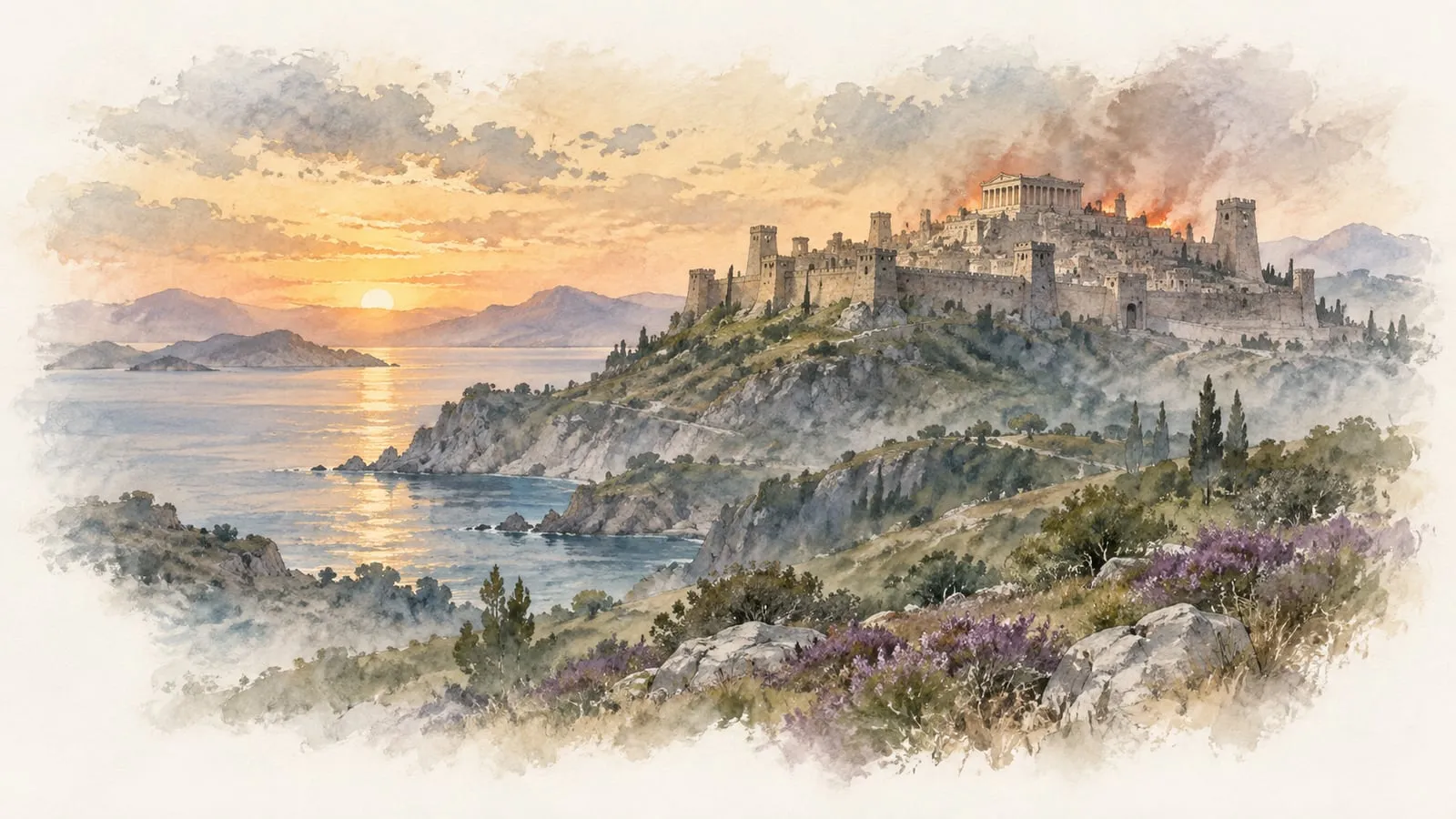
The old, he says, "should be hidden from their eyes". They are "holy shows", a sorry sight, bodies "broken like a thorn / Whereon the bleak north blows". Their minds are on "buried Hector", a hero of long ago whom "none living knows": the old live among memories nobody shares.
Lines 7 to 12The twisted thorn
The women "take so little stock" in him that they would leave their "cosseting" to hear "a jackass bray". The comedy turns in one line: "My arms are like the twisted thorn / And yet there beauty lay". The thorn image comes back, now holding a memory of love.
Lines 13 to 18Troy's destroyer
The woman who lay there was "The first of all the tribe", the one who "had brought great Hector down / And put all Troy to wreck": a Helen. The last line is startlingly physical. She took such pleasure that she cried into "this ear", "Strike me if I shriek".
Themes
Old age
The poem begins in humiliation. The old are "holy shows", "bodies broken like a thorn", ignored by women who prefer a braying jackass. Yeats does not soften any of it. Yet the image of the "twisted thorn" is turned round: the same broken body is the place where "beauty lay", and memory gives the old man a dignity no one else can see.
Memory and Troy
Troy frames the poem. The old think of "buried Hector", and the woman he remembers is the one who "brought great Hector down". His private memory of love is set on the scale of the Trojan War, and "none living knows" what he knows. The past is heroic, the present ridiculous.
Context
"His Memories" is the sixth poem in "A Man Young and Old", first collected in The Tower (Macmillan, 1928). After "The Empty Cup" the man is old, and from here on he speaks from memory. The thorn, which here stands for his broken body, returns as the "old thorn-tree" of young love in "Summer and Spring".
Yeats had long compared Maud Gonne to Helen of Troy, most famously in "No Second Troy", and the woman who "put all Troy to wreck" is usually read as another such figure for her. The poem keeps her unnamed, and its frank sensuality is new in his treatment of that theme.
Form
Three six-line stanzas in ballad metre, four-beat lines alternating with three-beat lines, with the short lines rhyming ("shows", "blows", "knows"; "say", "bray", "lay"). The last set of rhymes is slant ("take", "wreck", "shriek"), and the dashes that set off lines 15 and 16 hold back the ending so that the woman's cry lands hard.