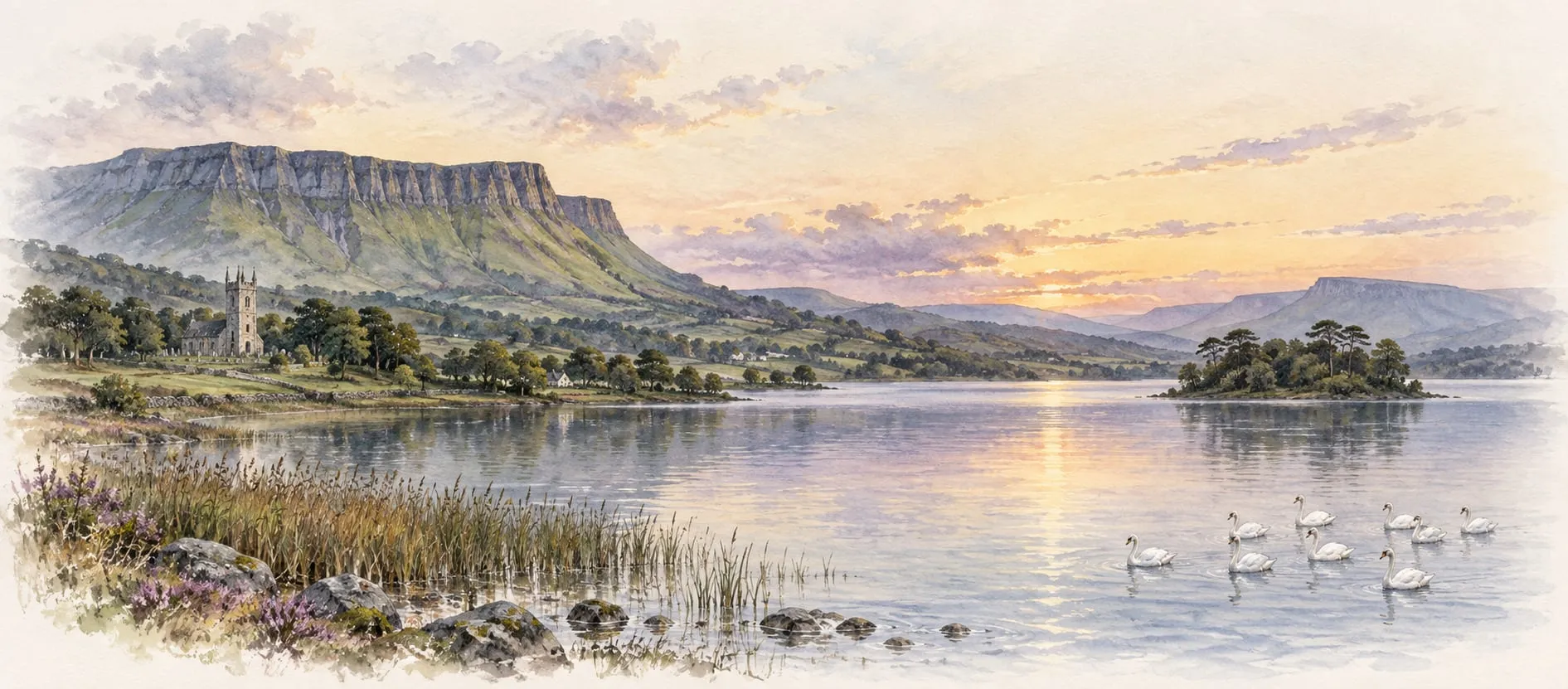
Before the World was made
Text: The Winding Stair and Other Poems (Macmillan, London, 1933). Public domain.
In brief
SummaryA woman at her mirror seeks the face she had before creation.
A woman speaks at her mirror. If she darkens her lashes, brightens her eyes and reddens her lips, she insists it is not vanity: she is "looking for the face I had" before the world began. In the second stanza she explains why she may look at a man as if he were her lover while her heart stays cold. He should not feel betrayed. She wants him to love that same original self, "the thing that was" before time. Make-up becomes a search for the soul's true form.
Lines to remember
I'm looking for the face I had
Before the world was made.
Line by line
Lines 1 to 8At the mirror
Making up her face "From mirror after mirror" looks like vanity, but she denies it: "No vanity's displayed". The refrain gives her real purpose. She is searching for the face she had "Before the world was made", an ideal self that cosmetics can only hint at.
Lines 9 to 16The cold lover
She may look at a man "As though on my beloved" while her blood stays cold and her heart "unmoved". She will not accept that this is cruel or a betrayal. What she wants him to love is "the thing that was" before creation, not the woman in front of him.
Themes
The ideal self
The refrain, "Before the world was made", points beyond the body to an original, eternal form of the self. Her face in the mirror is a copy she is trying to perfect. The idea recalls the Platonic belief that the soul existed before birth, and it turns an everyday act into a spiritual quest.
Love and distance
Her coldness in the second stanza follows from the first. If what matters is the eternal self, a lover's feelings for the living woman miss the mark. She asks him to love "the thing that was", not the passing person, which leaves him admired but held at arm's length.
Context
This is the second poem of "A Woman Young and Old", first published in The Winding Stair (New York, 1929) and collected in The Winding Stair and Other Poems (1933). After the father's anger in "Father and Child", the woman speaks for herself for the first time, and her concerns are already spiritual as well as bodily.
Form
Two eight-line stanzas of short three-beat lines. Lines 2 and 4 of each stanza rhyme or half-rhyme ("bright" and "right"), and each stanza closes on the refrain "Before the world was made", rhymed with line 6 ("displayed", "betrayed"). Both stanzas end in the same place, outside time.